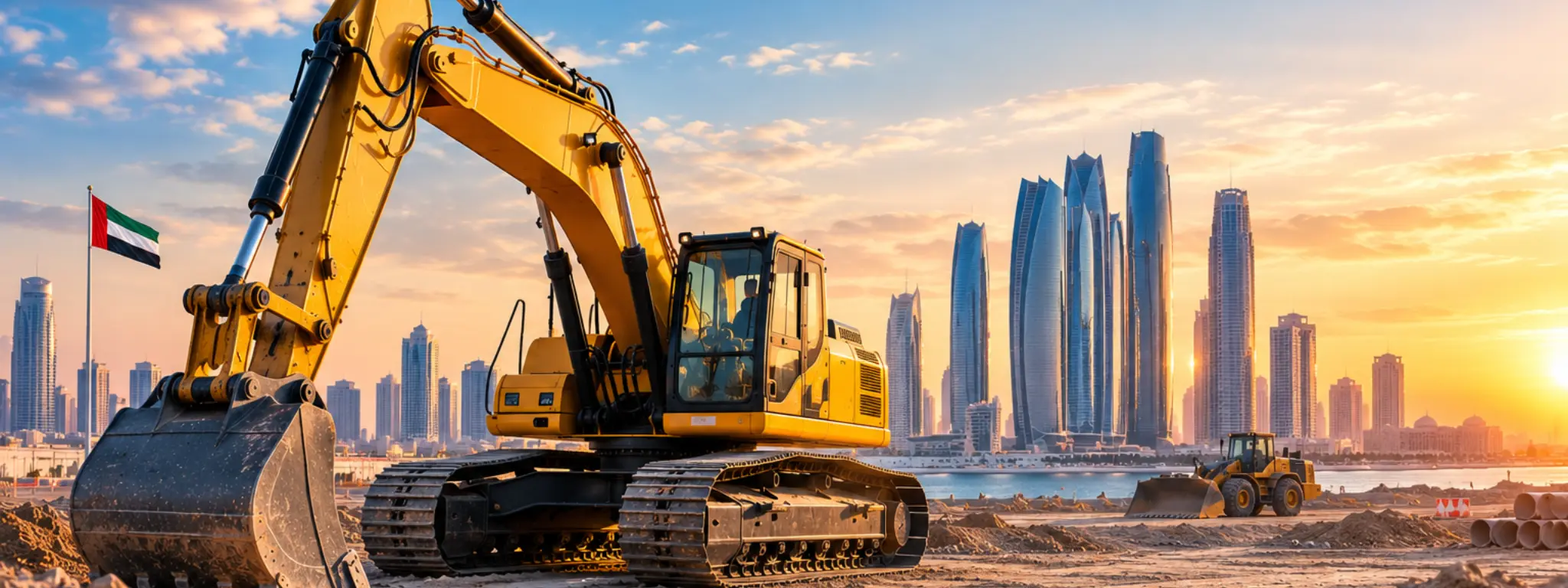
Excavator rental in Abu Dhabi runs from 3 and 5 tonne mini machines up to the Komatsu PC400 class at about 40 tonnes, on daily, weekly or monthly hire, as dry hire or wet hire with a certified operator. What you pay depends on operating weight, attachments, hire length and where the machine has to travel, so we quote per job rather than publish a rate card. Machinery working on Abu Dhabi sites must meet Department of Municipalities and Transport regulations, carry a valid third-party inspection (TPI) certificate, and hold the safety documentation required for industrial zones.

Selecting the right excavator configuration ensures your project maintains schedule efficiency while controlling operating expenditure. From utility trenching in Mussafah to large-scale infrastructure earthworks in Khalifa City or Ruwais, machine selection depends on soil conditions, bucket capacities, and depth requirements.

Excavator Size Classes for Abu Dhabi Worksite Requirements

Matching machine tonnage to earthmoving requirements prevents budget overruns and operational delays on site.

Mini and Midi Excavators (3 and 5 Tonne)

Our 3 and 5 tonne mini and midi excavators handle urban trenching, utility installation, drainage, low-rise foundations and landscaping on tight sites. Featuring short tail-swing designs, these units manoeuvre easily around existing structures.

Medium Excavator (20 Tonne)

The 20-tonne crawler excavator remains the workhorse of the UAE civil construction sector. These machines deliver balanced breakout force, reach, and stability for foundation excavation, road construction, and deep pipeline installations across sandy or consolidated terrain.

Heavy Excavator (Komatsu PC400, About 40 Tonne)

Heavy-class excavators target mass earthmoving, quarrying, and rock excavation. Fitted with a heavy-duty hydraulic hammer, our Komatsu PC400 class machines, about 40 tonnes, break caprock, hard limestone, and dense gypcrete common in the Abu Dhabi subsurface.

Excavator Class Operating Weight Primary Applications
Mini excavator 3 tonne Trenching, utilities and landscaping in tight access
Midi excavator 5 tonne Low-rise foundations, drainage and confined sites
Medium excavator (tracked or wheeled) 20 tonne Bulk excavation, roadworks, basements and site clearance
Heavy excavator (Komatsu PC400 class) About 40 tonne Mass earthworks, deep excavation and rock breaking
Long-boom excavator 20 tonne, extended reach Deep trenching, dredging and slope shaping

Essential Attachments for Abu Dhabi Subsurface Conditions

Abu Dhabi soil conditions vary from soft coastal sands to hard gypcrete and dense calcarenite rock. Standard earthmoving buckets are often insufficient for deep excavation without specialised attachments.

  1. Hydraulic Breakers (Rock Hammers): Heavy-duty breakers cut through hard caprock and concrete structures during site demolition or foundation works.
  2. Trenching and Heavy-Duty Buckets: Reinforced rock buckets with forged teeth withstand abrasive sandstone and coral rock conditions.
  3. Augers and Earth Drills: Used for drilling piling holes, fence posts, and utility pole footings without extensive ground disturbance.

Key Factors Influencing Excavator Hire Pricing

Understanding rental pricing structures helps contractors budget accurately for short-term projects or extended site development programmes.

  • Hire Duration: Daily rates carry higher overheads, whereas monthly or long-term contracts offer reduced daily equipment rates.
  • Wet Hire vs Dry Hire: Wet hire includes a certified operator and routine daily maintenance, while dry hire supplies the machine alone, requiring the contractor to furnish a licensed operator and fuel supply.
  • Attachment Selection: Adding a hydraulic breaker or specialised bucket incurs an additional daily or monthly surcharge above the base machine rental cost.
  • Mobilisation Logistics: Moving heavy excavators on lowbed trailers from Mussafah industrial hubs to remote sites like Al Dhafra or Ruwais incurs transport charges based on distance and route permits.

Regulatory Compliance and Site Access Standards in Abu Dhabi

Operating heavy machinery in Abu Dhabi requires strict adherence to safety and municipal regulations. Contracting companies must ensure equipment meets municipal and industrial zone entry rules.

Third-Party Inspection (TPI) Certification

Every excavator operating on a UAE job site must possess a current TPI certificate issued by an accredited inspection body that the project specification or the site owner accepts. TPI safety checks examine hydraulic lines, structural welds, cabin roll-over protective structures (ROPS) and emergency cutoff systems. Inspection covers the operator as well as the machine: every excavator we supply on wet hire comes with an operator certified for that class of machine, and we send both the machine and the operator certificates with the mobilisation paperwork.

CICPA and ADNOC Pass Approval

Projects located within critical infrastructure zones, oil fields, or refinery campuses require Critical Infrastructure and Coastal Protection Authority (CICPA) gate passes. Excavators entering these zones must pass stringent safety inspections, feature spark arrestors, external fire extinguishers, and carry valid driver/operator security clearances.

Steps to Rent an Excavator in Abu Dhabi

To ensure rapid deployment and avoid site downtime, follow this straightforward hiring procedure:

  1. Define Site Scope: Determine required digging depth, reach, material density, and ground clearance.
  2. Select Attachment Requirements: Specify whether standard buckets, heavy rock buckets, or hydraulic breakers are required.
  3. Verify Site Clearance Requirements: Confirm if the job site requires standard Abu Dhabi Municipality passes or specialised CICPA/ADNOC gate clearances.
  4. Review Transport and Access Points: Ensure lowbed transport trailers can access the site offloading area safely.
  5. Finalise Rental Terms: Choose between short-term hire or flexible long-term equipment rental in Abu Dhabi to optimise project cash flow.

Reliable Excavator Hire from Amirah Equipment Rental

Amirah Equipment Rental supplies fully inspected earthmoving machinery for UAE construction projects. Operating from key strategic supply hubs, we provide contractors with quality-assured industrial equipment, with certified operators and field service support.

Whether you need a 3 tonne mini excavator for urban utility work or a 40 tonne Komatsu PC400 with a hydraulic rock breaker for major civil infrastructure, our fleet is certified for immediate mobilisation across Abu Dhabi, Mussafah and the Western Region. Send us the machine, dates and site and we will confirm availability and price.

Frequently Asked Questions

What is the daily cost to rent an excavator in Abu Dhabi?

It depends on the machine and the job. The main factors are operating weight, whether you need wet hire with an operator or dry hire, which attachments you need such as a hydraulic breaker, how long you need it, and how far the lowbed has to travel. Send us the machine, dates and site and we will come back with a firm price.

Are operators included in Abu Dhabi excavator rental contracts?

Yes, standard hires are structured as wet hire, which includes a certified operator trained in UAE site safety protocols. Dry hire options without an operator are available for contractors with certified in-house operators.

What safety certificates are required for excavators working in Abu Dhabi?

Excavators must hold a valid Third-Party Inspection (TPI) certificate from an accredited UAE testing agency. For projects in oil, gas, or coastal infrastructure zones like Ruwais or ICAD, machines and operators must also have valid CICPA security passes.

How are rental excavators transported to site?

Machines are transported using dedicated lowbed heavy trailers from logistics centres in Mussafah or ICAD directly to the site. Mobilisation and demobilisation transportation charges are quoted based on distance and site access constraints.
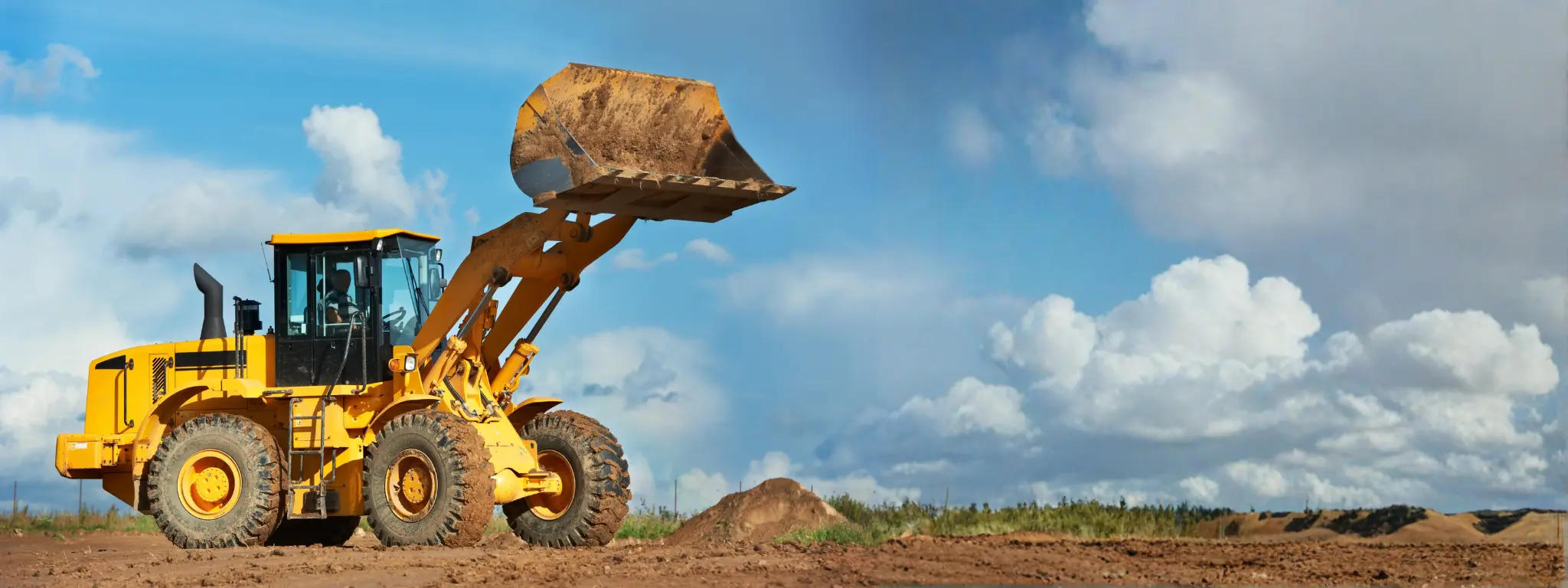
Selecting the right wheel loader size for construction and bulk material handling in the UAE directly impacts productivity, fuel consumption, and job site cycle times. The Caterpillar 950 wheel loader features an operating weight of 19 to 20 tonnes with a 3 cubic metre bucket, making it the standard choice for medium civil works, utility backfilling, and aggregate stockpiling. In contrast, the larger Caterpillar 966 offers an operating weight of 23 to 25 tonnes with a 4 cubic metre bucket, built for high-volume quarry work, primary earthmoving, and rapid loading of large multi-axle tipper trucks.

Matching machine capacity to site requirements prevents costly bottlenecks and excessive fuel expenditure. This guide compares performance metrics, bucket fill factors, site suitability, and regulatory standards for wheel loader rental in Abu Dhabi and the wider Western Region.

Understanding Wheel Loader Classes for UAE Construction Sites

Wheel loaders are rated primarily by operating weight, engine net horsepower, tipping load capacity, and bucket size. On job sites across Abu Dhabi, from Mussafah Industrial Area to offshore port developments in Khalifa Port, medium and heavy wheel loaders do most of the material handling.

Selecting between a 20-tonne class machine like the CAT 950 and a 25-tonne class machine like the CAT 966 involves evaluating the density of the material being moved:

  • Light Materials (1,000 to 1,400 kg/m³): Loose topsoil, dry sand, and agricultural products allow for larger bucket attachments without exceeding tipping limits.
  • Medium Density Materials (1,400 to 1,800 kg/m³): Crushed limestone, washed sand, sub-base gravel, and general excavated fill require standard earthmoving buckets to preserve machine balance.
  • High Density Materials (1,800+ kg/m³): Wet clay, blasted rock, and dense asphalt aggregates demand heavy-duty rock buckets and higher breakout forces to maintain cycle speeds.

In Abu Dhabi, loose desert sand and gatch layers present unique traction challenges. Heavy wheel loaders must deliver sufficient breakout force to penetrate undisturbed ground while maintaining stability on unpaved site access roads.

CAT 950 vs CAT 966 Specification Comparison

Evaluating technical specifications side-by-side helps site managers determine which payload capacity yields the lowest cost per tonne moved.

Feature / Specification CAT 950 (Medium Loader) CAT 966 (Heavy Duty Loader)
Operating Weight 19,000 – 20,500 kg 23,200 – 25,000 kg
Net Engine Power 168 – 186 kW (225 – 250 hp) 220 – 232 kW (295 – 311 hp)
Standard Bucket Capacity 3 m³ 4 m³
Full Turn Tipping Load 11,000 – 12,500 kg 14,500 – 16,000 kg
Breakout Force 150 – 165 kN 170 – 190 kN
Target Truck Match 10 to 15-tonne tippers 20 to 35-tonne heavy tippers
Average Fuel Consumption 14 – 18 litres/hour 22 – 28 litres/hour

The CAT 950 provides excellent mobility in confined urban work zones or busy equipment yards. The CAT 966 provides higher breakout force and structural weight, allowing operators to achieve full bucket loads in compacted materials without hydraulic strain.

Key Site Applications Across Abu Dhabi Infrastructure Projects

Both machine sizes serve distinct roles across civil construction, industrial operations, and primary infrastructure development across the emirate.

Civil Infrastructure and Roadway Development

For highway projects along the E11 and regional arterial road expansions, the CAT 950 is widely utilised for spreading base course aggregate, positioning backfill around drainage culverts, and feeding portable mixing plants. Its balanced turning radius makes it easy to manoeuvre within restricted lanes.

Aggregate Storage and Batching Plant Operations

In readymix concrete facilities and asphalt plants located in ICAD (Industrial City of Abu Dhabi) and Mussafah, wheel loaders run continuously. The CAT 966 is the preferred workhorse here, capable of keeping aggregate bins full during high-volume production runs. A CAT 966 can fill a 20 tonne tipper in three to four passes, drastically reducing haul truck cycle times.

Port Expansion and Coastal Earthworks

Marine reclamation projects require moving large volumes of wet dredged sand and heavy armour rocks. The added tipping load margin of the CAT 966 ensures stability when carrying dense loads over soft, uncompacted subgrades near water edges.

Earthmoving and Utility Support

On pipeline corridors in Habshan or desert infrastructure sites in Al Dhafra, wheel loaders perform multi-purpose roles. Contractors often pair loaders with smaller compaction tools, such as a plate compactor rental in Abu Dhabi, to prepare trench floors before pipe placement and backfilling operations.

Operational Efficiency: Fuel Economy and Pass-Matching

Optimising equipment productivity requires matching wheel loader bucket capacity to the haul trucks servicing the site. Mismatched machinery leads to extended idle times, wasted fuel, and site congestion.

  1. Calculate Truck Capacity: Determine the internal volume and maximum payload limit of your haulage fleet (e.g., 18 m³ tipper trucks).
  2. Determine Pass Counts: Aim for a 3-pass or 4-pass loading strategy. Loading a truck in fewer than 3 passes risks shock-loading the truck bed, while taking more than 5 passes creates traffic delays at the loading zone.
  3. Evaluate Cycle Times: A standard loader cycle (load, reverse, turn, dump, return) takes between 30 and 45 seconds under normal operating conditions. A CAT 966 moving 4 cubic metres per pass moves roughly 320 to 480 cubic metres of loose material per hour.
  4. Monitor Fuel Burn: Fuel represents a major operational expense in heavy civil earthmoving. While a CAT 950 burns approximately 14 to 18 litres per hour, a CAT 966 burns 22 to 28 litres per hour under heavy loading. If site layout or material supply delays prevent the 966 from operating at high capacity, renting a 950 offers lower hourly running costs.

Abu Dhabi summer temperatures frequently exceed 45°C. Rental wheel loaders operating in these extreme conditions must feature heavy-duty cooling packages, clean radiator cores, and high-capacity air filtration systems to prevent thermal derating and component wear.

Site Access Compliance and Safety Standards in Abu Dhabi

Operating heavy construction equipment in Abu Dhabi requires strict adherence to safety and environmental regulations governed by municipal authorities and project owners.

  • Third-Party Inspection Certificates: All rental wheel loaders entering commercial or government job sites must hold valid Third-Party Certificates issued by an accredited inspection body that the project specification or the site owner accepts. These certificates verify structural integrity, brake testing, and hydraulic safety valve operation.
  • Operator Qualifications: Operators must hold a valid UAE heavy equipment driving licence. On high-security sites, operators require specialised safety induction cards and medical fitness clearance.
  • Critical Infrastructure Gate Passes: Projects operating within oil and gas concessions or critical infrastructure zones require security clearances (CICPA passes) from the Critical Infrastructure and Coastal Protection Authority for both the machinery and the operator.
  • Environmental and Noise Limits: Equipment must meet the emission and noise limits set out in the project specification and by the authority with jurisdiction over the site, to limit environmental impact on active public works.
  • Tax Compliance: All machinery rental transactions in the UAE are subject to the standard 5% UAE VAT, with proper tax invoices specifying site delivery locations and operational terms.

Rental Structure: Short-Term vs Long-Term Equipment Hire

Contractors evaluate equipment procurement based on project timeline, capital availability, and site maintenance resources. Equipment hire is structured into standard operational formats:

  • Daily and Weekly Rental: Suitable for emergency backfill, short-term clearing, or temporary plant maintenance cover.
  • Monthly Dry Hire: The contractor supplies fuel and operator, while the rental supplier provides the fully serviced wheel loader and routine maintenance support.
  • Monthly Wet Hire: The rental supplier provides the machine, certified operator, routine maintenance, and mobilisations, simplifying payroll and operator management.

For major civil infrastructure packages running over six months, securing long-term equipment rental in Abu Dhabi locks in preferential monthly rates, removes balance-sheet depreciation risks, and covers replacement machinery during scheduled major servicing where the contract says so.

Partnering with Amirah Equipment Rental

Amirah Equipment Rental supplies inspected heavy machinery across Abu Dhabi, Mussafah, and the Western Region. Our rental fleet includes wheel loaders, earthmoving machinery and specialised plant.

Every wheel loader in our fleet undergoes rigorous pre-mobilisation checks to meet stringent site entry requirements. Beyond wheel loaders, we rent a wider range of plant, from earthmovers to quality-assured industrial equipment.

Our logistics team manages lowbed transport logistics directly to your job site, providing operational support, site-certified operators and field maintenance response.

Frequently Asked Questions

What is the main difference between a CAT 950 and CAT 966 wheel loader?

The primary differences are operating weight, engine power, and bucket size. The CAT 950 is a 19-to-20-tonne loader with a 3 m³ bucket, suited for medium civil earthmoving and utility work. The CAT 966 is a larger 23-to-25-tonne loader with a 4 m³ bucket, designed for high-capacity quarrying, batching plant feeding, and heavy truck loading.

Are wheel loader rentals in Abu Dhabi supplied with an operator?

Rental agreements can be configured as dry hire (machine only) or wet hire (machine with a fully certified, licensed operator). Wet hire ensures the operator holds valid UAE heavy machinery licences and site safety inductions.

What safety certification is required for wheel loaders on Abu Dhabi job sites?

Wheel loaders must possess a valid Third-Party Inspection Certificate issued by an accredited safety organisation in the UAE. Machinery working on ADNOC or industrial infrastructure sites also requires specific security gate passes and safety fittings, such as reverse alarms, flashing beacons, and fire extinguishers.

How does bucket size affect fuel consumption during material handling?

Using an oversized bucket in dense material can overload hydraulics, cause wheel spin, and increase hourly fuel burn without increasing tonnage output. Conversely, using a bucket that is too small requires extra passes to load trucks, burning unnecessary fuel over time. Pass-matching the loader bucket to material density and truck bed volume ensures optimal fuel economy.

Heavy equipment rental in Abu Dhabi enables commercial contractors to secure certified machinery without long-term capital commitment. Equipment hire across the emirate encompasses earthmoving plant, mobile lifting units, and site utilities fitted with Third-Party Inspection (TPI) certificates and Critical Infrastructure and Coastal Protection Authority (CICPA) clearances. Choosing flexible rental contracts turns fixed machinery overheads into project costs while maintaining compliance with local building authorities.

Commercial construction across Abu Dhabi demands strict operational efficiency. Commercial developers and infrastructure contractors have to work around the heat, rigorous safety audits and strict site deadlines. Securing the right fleet ensures project schedules remain on budget while adhering to regional construction standards.

Commercial Infrastructure Growth in Abu Dhabi for 2026

Abu Dhabi continues to expand its industrial and commercial footprint across strategic hubs such as Mussafah, Khalifa Economic Zones Abu Dhabi (KEZAD), Yas Island, and Al Dhafra. Major land development, civil infrastructure, and commercial builds require earthmoving, site clearance, and structural assembly plant capable of heavy output in hot climate conditions.

Municipal oversight in Abu Dhabi sits with the Department of Municipalities and Transport, which sets the operational standards for mechanical plant deployed on public and private projects. Contractors must ensure every machine brought to site meets current emission controls, noise restrictions, and safety verification guidelines before work commences.

Key Machinery Categories for Commercial Projects

Commercial sites rely on a mix of heavy earthmoving machinery, compaction equipment, and supporting site power units. Selecting the appropriate machine capacity prevents project delays and excess fuel consumption.

Earthmoving and Excavation Machinery

Heavy excavators ranging from 20 to 40 tonnes form the foundation of site preparation. Fitted with buckets, hydraulic breakers, or rippers, excavators handle deep trenching, foundation digging, and rock breaking in hard substrate environments. Wheel loaders complement excavators by moving bulk aggregates, backfilling trenches, and loading material trucks efficiently.

Site Lighting

Continuous work requires reliable site lighting. Mobile lighting towers allow extended night shifts, and lighting tower rental in Abu Dhabi lets main contractors scale coverage to the site without maintaining idle machinery.

Equipment Type Typical Capacity Range Key Commercial Applications
Hydraulic Excavators 20T to 40T Bulk earthworks, deep foundation trenching, rock breaking
Wheel Loaders 3 m³ to 4 m³ bucket Material rehandling, site clearing, aggregate loading
Motor Graders 12ft to 14ft blade Road grading, sub-base levelling, site finishing
Mobile Lighting Towers LED or metal halide, 1 to 4 lights, 5 to 15+ m mast Night operations and site security lighting

Compliance, CICPA Passes, and Safety Standards

Deploying machinery in sensitive industrial zones, oilfields, and coastal development areas requires strict regulatory compliance. Commercial contractors cannot afford site entry delays caused by non-compliant documentation.

  1. Third-Party Inspection (TPI) Certificates: All mechanical plant must hold valid TPI certification issued by an accredited inspection body that the project specification or the site owner accepts. Certificates confirm structural integrity, hydraulic safety, and emergency stop functionality.
  2. CICPA Security Approvals: Projects located near ports, energy installations, or restricted zones require CICPA driver and equipment security clearance passes.
  3. Operator Certification: Heavy machinery operators must carry valid UAE heavy equipment driving licences alongside the safety training credentials the site owner requires.
  4. ADNOC Offshore & Onshore Onboarding: Oil and gas commercial sub-contracts frequently mandate specific spark arrestors, external emergency cut-offs, and daily maintenance logs.

Working with suppliers offering quality-assured industrial equipment ensures machines arrive with full maintenance logs and current inspection tags ready for site entry.

Financial Comparison: Rental vs. Direct Capital Expenditure

Contractors continuously balance machinery acquisition costs against working capital constraints. Purchasing heavy equipment involves substantial initial capital outlay, bank interest fees, storage costs, and ongoing maintenance salaries. Conversely, hiring equipment transforms fixed capital costs into variable operational costs.

Buying: initial capital outlay, then depreciation, routine maintenance and the cost of idle time.

Renting: a monthly operational fee that stays a fixed project expense, with replacement machinery available and no depreciation to carry.

Equipment rental is an operating cost rather than a capital purchase, so how it is treated for corporate tax is a question for your tax adviser. Renting improves cash flow predictability and allows companies to tender for larger commercial contracts without straining line-of-credit limits.

Arranging a structured long-term equipment rental in Abu Dhabi allows project managers to fix machinery costs over 6 to 24 month timelines, eliminating unexpected repair invoices.

Key Terms in Commercial Machinery Rental Contracts

Before executing a commercial machinery agreement in Abu Dhabi, commercial teams must review specific lease parameters:

  • Working Hour Limits: Standard monthly rental agreements typically cover 240 operating hours per month (10 hours per day for 24 working days). Overtime hours are calculated at pro-rata hourly rates.
  • Dry Hire vs. Wet Hire: Dry hire includes the machinery alone, leaving fuel and operator management to the hirer. Wet hire includes certified operators and routine field servicing, shifting operational risk to the hire company.
  • Repair Response SLAs: Service level agreements must specify site breakdown response windows (agreed with the supplier before the hire starts) to minimise site downtime.
  • Mobilisation Charges: Transport fees cover delivery from the supplier yard to the jobsite and return journey charges upon off-hire notice.

Why Contractors Choose Amirah Equipment Rental

Amirah Equipment Rental provides reliable heavy plant solutions across Abu Dhabi, Mussafah, and the wider UAE. Amirah supplies excavators, loaders, compaction plant and site utilities to commercial contractors across the emirate.

Machines are inspected before delivery and sent with their current TPI paperwork. Whether you require single-day hire for site clearing or dedicated fleet machinery for multi-year civil works, Amirah offers flexible rental terms with field service support.

Frequently Asked Questions (FAQ)

What documentation is required to rent heavy equipment in Abu Dhabi?

Commercial hirers must provide a valid UAE Trade Licence, VAT Registration Certificate, signed rental agreement, and purchase order. Site access may also require valid operator UAE driving licences, Third-Party Inspection (TPI) cards, and security passes such as CICPA clearance.

How are rental equipment transport and mobilisation costs calculated?

Mobilisation and demobilisation fees are billed based on distance from the supplier yard in areas like Mussafah or ICAD to the project location. Flatbed or low-bed trailer transport costs are normally itemised separately from daily or monthly equipment rental rates.

Are operators included in heavy equipment rental agreements?

Equipment hire can be arranged on either a dry-hire basis (machinery only) or wet-hire basis (machinery with a certified operator and fuel management). Most large infrastructure projects in Abu Dhabi mandate certified, experienced operators.

How does equipment rental affect UAE VAT calculation?

Heavy equipment rental services are subject to standard 5% UAE VAT administered by the Federal Tax Authority (FTA). Registered commercial contractors can reclaim input VAT on tax invoices issued by compliant equipment rental companies.

© 2026, All Rights Reserved, Amirah Equipment Rental. Privacy Policy  ·  Terms  ·  Cookies